
5 Ways to Create a More Focused Workday



7 min
Some workdays seem to disappear before you’ve had a chance to get properly started. You move from emails to meetings, jump between small tasks, respond to whatever feels most urgent, and, by the end of the day, wonder where the time went.
A more focused day doesn’t necessarily mean doing more. It means being more intentional about what deserves your time and attention and creating enough structure around your day to make that easier.
The good news is that you don’t need an overly complicated routine or a perfectly planned schedule. A few simple habits can make a busy day feel calmer, clearer and much more manageable.
Here are five simple ways to create a more planned and focused workday.
How to Create a More Focused Workday
1. Plan Your Day Before It Starts

One of the easiest ways to feel more in control of your day is to decide what you want it to look like before emails, notifications, meetings and unexpected tasks begin competing for your attention.
Take five or ten minutes at the beginning of the day, or at the end of the previous one, to look at what’s ahead. Check your appointments, note any deadlines, and write down the tasks you’d like to move forward. Having everything in one place gives you a clearer picture of how much time you actually have available and can stop you from creating an unrealistic to-do list.
Research also supports this approach. A 2026 study by the University of Limerick found that a programme designed to help people organise and self-regulate their workday increased their confidence in managing their work and reduced work–life conflict. It’s a useful reminder that adding structure to the day can help us feel more in control of our work, rather than simply reacting to whatever comes our way.
This is where a good planner can make a real difference. Instead of trying to hold your schedule, priorities, deadlines, and reminders in your head, you have one place to map out the day in front of you. The aim isn’t to plan every minute or create a schedule that leaves no room for change. It’s simply to give your day some direction before it begins, so you’re less likely to spend the first few hours reacting to whatever happens to appear in front of you.
2. Choose Your Most Important Priorities

A long to-do list can easily make it seem like everything on it matters equally, when in reality some tasks will have a much bigger impact than others.
Instead of beginning your day by working through your list from top to bottom, identify the two or three things that would make the biggest difference if you completed them. Ask yourself: If I only moved a few things forward today, what would I want them to be?
Your priorities might include finishing a focused piece of work, making progress on an important project, preparing for an upcoming deadline or finally dealing with something that has been hanging over you for days. Once you know what matters most, you can give those tasks the best parts of your time and energy rather than trying to squeeze them in after everything else. You’ll still have smaller jobs, emails and admin to take care of, but they no longer have to dictate the shape of your entire day.
3. Give Important Work A Place in Your Schedule

Writing something on a to-do list tells you what you need to do. Deciding when you’ll do it makes it much more likely to happen.
Look at the time you have available and create space for your most important tasks. You might block out an hour in the morning for focused project work, set aside thirty minutes after lunch for admin or group several similar smaller tasks together later in the afternoon. This doesn’t have to become a rigid timetable. Think of it as giving your priorities an appointment with you. When an important task has a place in your schedule, it becomes something you’ve actively made time for rather than something you hope you’ll eventually get around to.
Planning this way can also help you notice when you’re simply trying to fit too much into one day. If your calendar is already full of meetings and commitments, adding another ten tasks to your list won’t magically create more time. Looking at your to-do list alongside your schedule makes it easier to set realistic expectations and decide what you can genuinely achieve. That, in turn, makes finishing the day with a sense of accomplishment far more achievable.
4. Stay Focused on What Matters

Once you’ve created time for focused work, the next challenge is protecting it.
Notifications, incoming emails, messages and quick requests can easily turn one task into five. Even small interruptions can break your concentration, and it often takes longer than we realise to settle back into the work we were doing. Try setting aside short periods during the day to deliberately reduce distractions. Put your phone out of reach, close browser tabs you don’t need, silence non-essential notifications, and let messages wait while you spend thirty or sixty minutes concentrating on one thing.
Your physical environment can make a difference too. If you work in a busy office, moving to a quieter area or designated focus zone can help create some separation from conversations, movement and other distractions. Even without a dedicated room, simple changes such as choosing a low-traffic area, using privacy screens or acoustic solutions, and keeping your workspace comfortable and uncluttered can make it easier to concentrate. We’ve explored this in more detail in our guide to creating a focus zone in any office.
It can also help to keep a notepad or running list nearby for anything that pops into your head while you’re working. Instead of switching tasks the moment you remember an email you need to send or something you need to look up, make a quick note and return to what you were doing. Knowing you’ve captured the thought somewhere makes it easier to set it aside for later.
Focus doesn’t have to mean finding three uninterrupted hours in your day. For most of us, that isn’t particularly realistic. A few well-protected pockets of attention can be enough to make meaningful progress on what matters.
5. Leave Room for the Unexpected
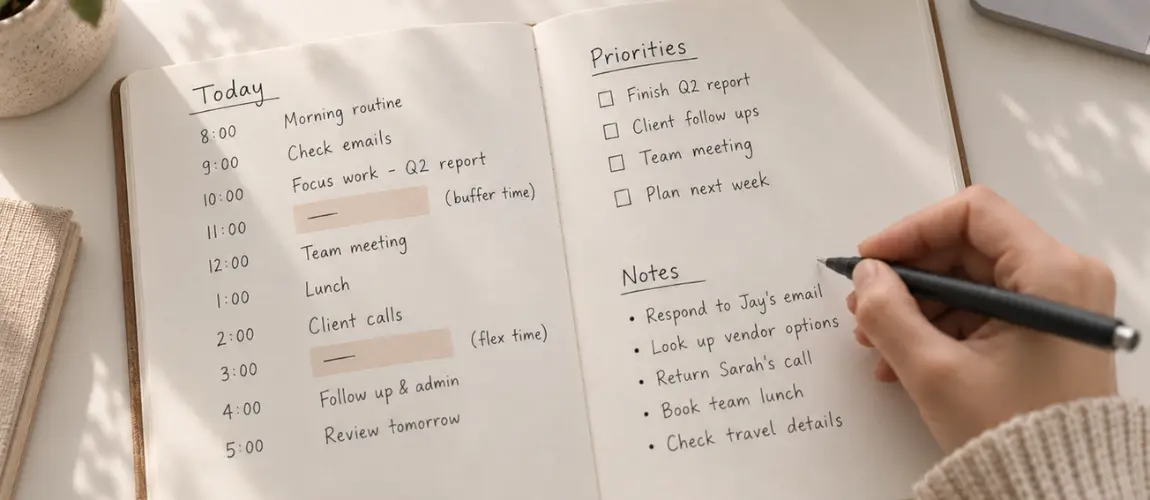
A productive plan also needs some breathing room.
When every part of your day is packed back-to-back, it doesn’t take much for the whole schedule to start feeling unmanageable. One meeting runs over, an urgent email arrives, or someone needs something you didn’t plan for, and suddenly everything else gets pushed further back.
Rather than planning your day to 100% capacity, leave a little white space between tasks or keep part of your day deliberately unallocated. That gives you room to absorb what you couldn’t anticipate without automatically sacrificing the work you planned. And when plans do change, which they inevitably will, return to your priorities rather than abandoning the day altogether. Look again at what matters most, decide what can be moved and adjust the plan from there.
A useful plan should support you. It shouldn’t make you feel as though you’ve failed simply because real life refused to follow the schedule.
A Focused Day Starts with a Little Intention
Creating a more focused workday isn’t about becoming perfectly productive or controlling every hour. In fact, some of the most common productivity myths, from multitasking to working longer hours, can make it harder to do your best work. As we explored in our previous blog about popular productivity myths, being productive is often less about doing more and more about working with greater intention.
What matters most today? When will you work on it? What can wait until another day? Where do you need to protect your attention, and where do you need to leave a little flexibility?
With a clear plan, realistic priorities and one place to organise everything, the day starts to feel less like a stream of things happening to you and more like something you can actively shape. Sometimes, that little bit of structure is all it takes to turn a busy day into a much more manageable one.
---
Sometimes, having the right place to bring your priorities, plans and ideas together can make all the difference. A little structure can create more clarity, more focus and a calmer way to move through the day. We’ve been thinking about it a lot lately — and we’ll have more to share soon. Stay tuned!
RELATED ARTICLES:
Latest Posts


 Neuroinclusion in the Workplace
Different Working Styles Need Different Ways to Plan
Why do some planning systems work brilliantly for one person but not another? Dr Áine O'Dea explores how executive functioning, neurodiversity, and different working styles shape how we plan, prioritise, and manage our workday.

 Workplace Wellbeing
6 Ways to Move More and Support Mental Health at Work
Supporting your mental health at work can be as simple as moving more throughout the day. Discover six practical ways to build movement into your workday, whether you work in an office, remotely or in a hybrid role.